
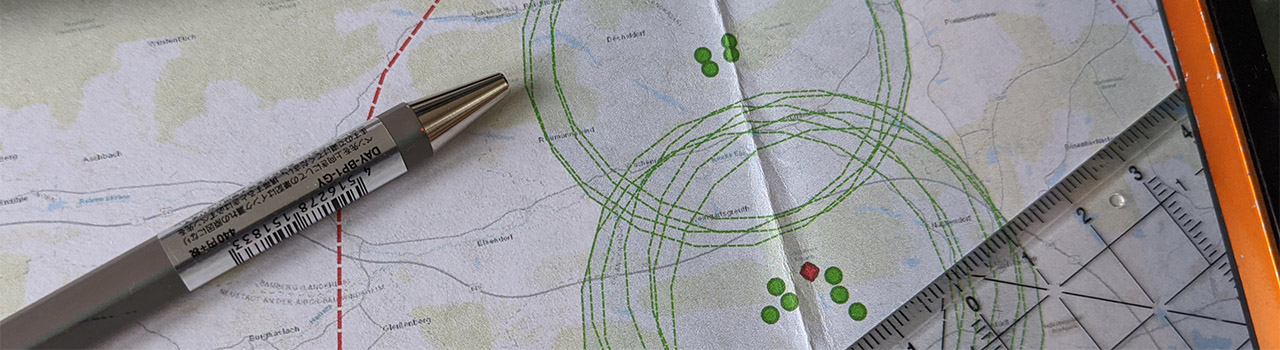
What BNK and ADLS mean, how they work, and why Lanthan, as a co-inventor of the BNK transponder, continues to this day to supply open-system, BNK/ADLS-compatible obstacle lighting.
BNK stands for Demand-Driven Night Marking—a system that activates the obstacle lights on wind turbines, high-rise buildings, and other aviation obstacles only when an aircraft is actually approaching. Internationally, the term ADLS (Aircraft Detection Lighting System) is commonly used for this purpose—both terms describe the same operating principle.
Instead of flashing throughout the entire night, the system detects an approaching aircraft via radar, transponder, or camera and only then activates the lighting. This significantly reduces light pollution and the burden on residents without compromising flight safety.
Co-invented by Lanthan
Lanthan has been working on the development of the transponder-based BNK/ADLS since 2004 — one of the first methods for reliably detecting approaching aircraft via transponder signals in order to control the lighting system as needed. The system was first installed at the Wiemersdorf wind farm in 2008 – the first of its kind in the world – and has been in successful operation ever since.
In April 2020, Lanthan contributed the technology to the newly founded Lanthan Safe Sky (LSS) — together with fellow shareholders Recase and Air Avionics, who have jointly continued to develop the method ever since.
Lanthan itself does not manufacture or sell BNK/ADLS control systems. What Lanthan supplies are the obstacle lighting systems themselves — designed to work with any standard BNK/ADLS system, regardless of the control system manufacturer. When it comes to implementation, Lanthan provides manufacturer-neutral advice and arranges comprehensive packages — whether through LSS or any other provider on the market.
Why Open-System Lighting Matters
Anyone investing in a BNK/ADLS system commits to a control system provider—but not necessarily to a specific manufacturer of the obstacle lights themselves. Lanthan lights are deliberately designed to be manufacturer-independent and open-system:
- Compatible with common BNK/ADLS control systems on the market
- No dependence on a single control system provider
- Future-proof in the event of a provider change or system expansion
- Certified according to German and international regulations (AVV, ICAO)
This makes Lanthan the ideal partner for operators seeking BNK/ADLS-compatible obstacle lighting without being tied to a specific control solution.